
Conversion goals & values
Review primary versus secondary conversion actions, purchase-value accuracy, lead-quality feedback, duplicate events and value-based bidding readiness. PMax cannot compensate for unreliable measurement.
Performance Max campaign management for e-commerce stores and lead-generation advertisers. I audit primary conversion actions, purchase values or qualified-lead signals, Merchant Center product coverage, asset groups, brand controls and bidding targets before changing campaign structure.
Independent Google Ads specialist • Shopify & WooCommerce • US & UK advertisers
Performance Max can serve across eligible Google channels, including Search, Shopping, YouTube, Display, Discover, Gmail and Maps. Its automated decisions depend on your conversion goals, assets, feed quality, bidding settings and available data.
If purchase values are duplicated, a low-margin product dominates the feed, or a lead campaign counts every enquiry as equally valuable, the account can optimize toward metrics that don't reflect the business outcome you need.
Best suited for: e-commerce stores with Merchant Center inventory, established PMax advertisers seeking a structured audit, and lead-generation businesses with reliable conversion feedback.
From conversion-action selection and listing-group coverage to URL expansion and search themes, these are the practical inputs I check before recommending budget or target changes.
Review primary versus secondary conversion actions, purchase-value accuracy, lead-quality feedback, duplicate events and value-based bidding readiness. PMax cannot compensate for unreliable measurement.
For retailers, assess Merchant Center eligibility, product IDs, custom labels, margin-sensitive categories, stock availability and listing-group inclusion. Keep low-value or unsuitable inventory from receiving unintended priority.
Align assets and final URLs with meaningful product or service themes. Review text, imagery, video availability and asset coverage; avoid assuming asset-group reporting proves individual creative causality.
Use first-party audiences, custom segments and search themes where appropriate to guide discovery. Audience signals are not strict audience targeting and do not confine delivery to those users.
Review brand exclusions, negative keywords where supported, final URL expansion, URL exclusions, location settings and account-level suitability controls. Availability varies by campaign and account.
Assess budget, Maximize Conversions or Conversion Value, optional CPA/ROAS targets, learning stability, search-term insights and available channel reporting. Make changes against a documented hypothesis.
An anonymized e-commerce Performance Max campaign reported the following Google Ads attributed figures between 1 August and 9 October 2026.
The reporting screenshot does not independently verify actual store revenue, net profit, incremental impact or whether the retailer used Shopify.
See related Shopping services ↗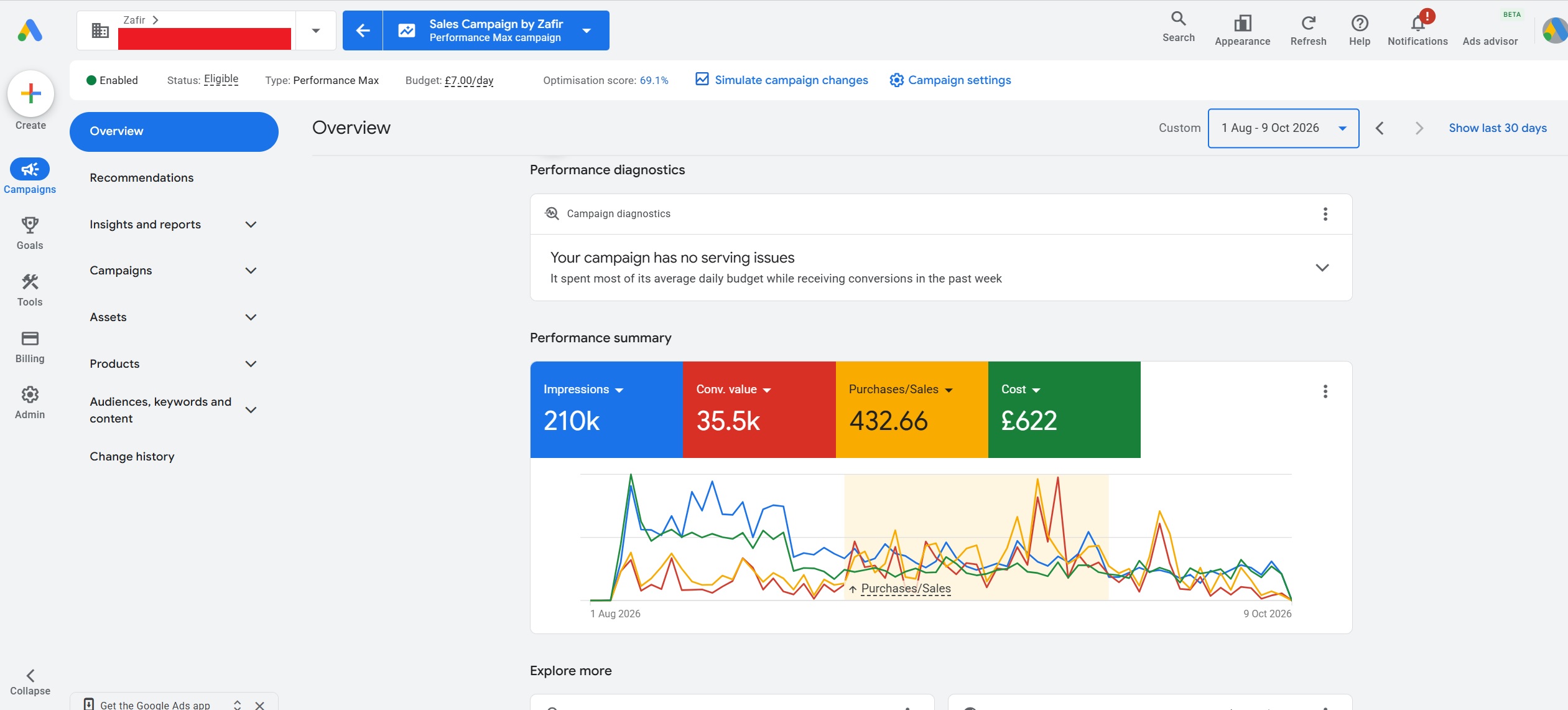
The account also reported approximately 210K impressions and 432.66 fractional sale/purchase conversions. These are not verified unique orders. This single example is not a prediction, a profit statement or proof of causality; results vary by advertiser.
Check goals, purchase or lead values, account history, Merchant Center, campaign overlap and existing assets.
Choose campaign boundaries, asset themes, product selection, URLs, controls and bidding objectives.
Implement prioritized changes while respecting conversion-data quality, budget and learning stability.
Review attributed results, available channel/search insights, product economics or qualified leads, then plan the next test.
For an online store, PMax depends heavily on eligible product data, purchase measurement and realistic margins. If items are disapproved or feed attributes are inconsistent, my Google Merchant Center management service focuses on the product-data and eligibility issues before campaign optimization. Google Shopping management may be a useful comparison when product-focused controls matter.
For a Shopify business, my Shopify PPC management service covers the broader relationship between Search, Shopping, Performance Max, feed quality and store economics.
Not automatically. Campaign roles depend on inventory, query intent, available controls and business objectives. Review existing Search and Shopping campaigns before consolidating or expanding PMax.
No. Audience signals help guide automated learning, but Performance Max can reach people beyond those signals when Google's systems predict relevant conversions.
Relevant brand exclusions, negative keywords and final URL settings may be available, depending on the account and campaign. I audit those controls instead of assuming every PMax account offers identical options.
A target ROAS can be appropriate when conversion-value data and business objectives support it. Setting an aggressive target without reliable data may constrain delivery; there is no universal starting number.
Where dependable CRM or sales feedback is available, I compare reported conversions with qualified leads and downstream outcomes. Without that feedback, form-fill volume alone is an incomplete quality measure.
No. Demand, competition, conversion quality, product margins, website experience and account history all influence results. I provide accountable management, not guaranteed outcomes.
Bring your Google Ads campaign results, conversion goals, Merchant Center status and product margins or lead-quality criteria. We'll identify what needs investigation before you change targets or increase spend. Choose an available time for a free 30-minute consultation.
Book a discovery call ↗